

The Authorities which I Have Called to Lay the Foundation of Zion
Reflections on Doctrine and Covenants Section 124 (Part 4)

In the previous posts I outlined the historical background for Doctrine and Covenants Section 124, began to examine and appreciate the revelation itself, commented on the Lord’s commandment to build a House to His Name in Nauvoo, and discussed the Lord’s counsel and blessings to His plants of renown and watchmen upon her walls. In this post, lets continue our study of, and commentary on, the longest section in the Doctrine and Covenants: Doctrine and Covenants Section 124.
And again, verily I say unto you, if my servant Sidney will serve me and be counselor unto my servant Joseph, let him arise and come up and stand in the office of his calling, and humble himself before me.
And if he will offer unto me an acceptable offering, and acknowledgments, and remain with my people, behold, I, the Lord your God, will heal him that he shall be healed; and he shall lift up his voice again on the mountains, and be a spokesman before my face.
Let him come and locate his family in the neighborhood in which my servant Joseph resides.
And in all his journeyings let him lift up his voice as with the sound of a trump, and warn the inhabitants of the earth to flee the wrath to come.
Let him assist my servant Joseph, and also let my servant William Law assist my servant Joseph, in making a solemn proclamation unto the kings of the earth, even as I have before said unto you.
If my servant Sidney will do my will, let him not remove his family unto the eastern lands, but let him change their habitation, even as I have said.
Behold, it is not my will that he shall seek to find safety and refuge out of the city which I have appointed unto you, even the city of Nauvoo.
Verily I say unto you, even now, if he will hearken unto my voice, it shall be well with him. Even so. Amen. (D&C 124:103-110)
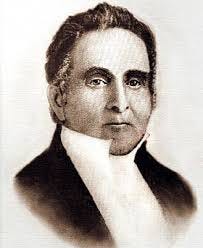
The Lord’s blessings and counsel to His servant Sidney Rigdon are extensive and specific. Sidney Rigdon played a special role in the Restoration of the Gospel of Jesus Christ (see also here), not unlike the role of Aaron, the spokesman for Moses.
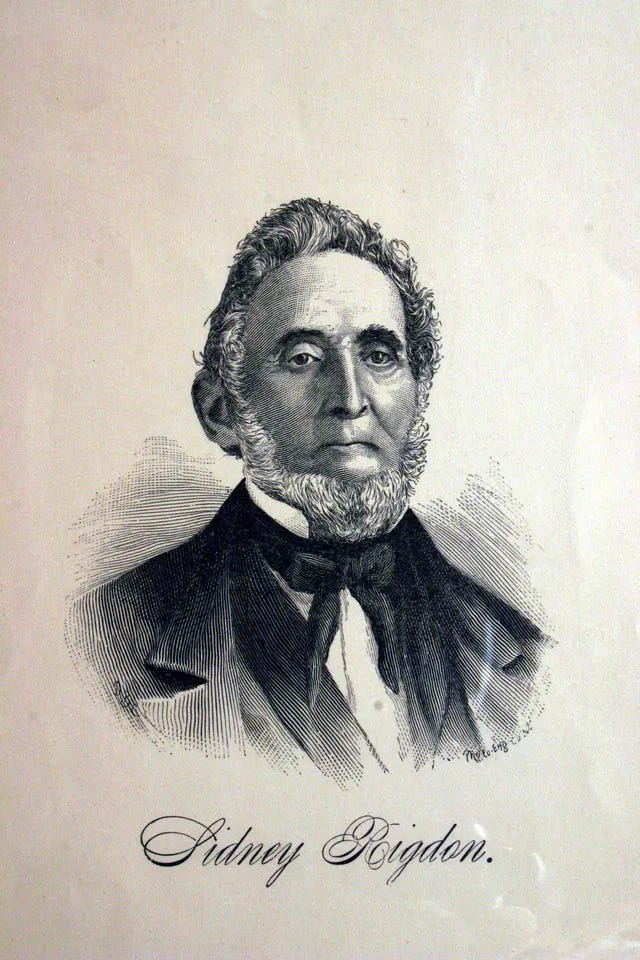
(e) Sidney Rigdon.
103-10. Sidney Rigdon, according to a generally prevailing impression, was more or less, under the influence of a spirit of apostasy. It is related that, in Liberty jail, he declared to his fellow-prisoners that the sufferings of the Lord were nothing compared with his, and while the faithful Saints were straining every nerve to complete the Nauvoo Temple, he had not word of encouragement to them. As a consequence of his disposition, he did not have good health. Like the Corinthians who partook unworthily of the Sacrament (I. Cor. 11:30), he was “weak and sickly.” The Lord, therefore, points out to him the cause of his ailments and promises to heal him, if he will do his duty and stand by the Prophet as a true counselor.
Sidney Rigdon had a remarkable experience some months after this Revelation was received. His daughter Eliza took sick and was pronounced dead by the physician. Some time after her departure, she rose up in the bed and said she had returned to deliver a message from the Lord. She then called the family around her. To her sister Nancy she said, “It is in your heart to deny this work; and if you do, the Lord says it will be the damnation of your soul!” To her sister Sarah she said, “We have but once to die, and I would rather die now, than wait for another time.” After having spoken for some time she fainted, but recovered again. The following evening she called her father and said to him that the Lord would make her well, if he would cease weeping for her. Sidney Rigdon related this manifestation of the power of God, in a public meeting on the 20th of August, 1842, and added a strong declaration of his allegiance to the Prophet Joseph and the Church. On the same occasion, Hyrum Smith cited Sidney Rigdon’s mind back to this Revelation, in which the Lord promised that if he would move into the City and defend the truth he would be healed, and showed that Rigdon’s improvement in health was a fulfilment of this revelation (Hist. of the Church, Vol. V., pp. 121-3). But, notwithstanding all, Rigdon finally lost his way. It can be said, however, that, according to his son, John Rigdon, who joined the Church, he never was an enemy of the Church. (pp. 788-789)
Sidney was given a conditional blessing. He was to do the thing that he had been called and ordained to do. he was to be a counselor to Joseph, a spokesman for Joseph, help with the proclamation to the world, and not move to the east (vv. 103-109). If he did these things, it would be well for him (v. 110). If he did not do them, it is implied that it would not be well for him. Unfortunately, he chose not to follow counsel, and it was not well for him. We will leave further commentary to a study of Church history. (p. 496)
The revelation in D&C 124 continues:
And again, verily I say unto you, let my servant Amos Davies pay stock into the hands of those whom I have appointed to build a house for boarding, even the Nauvoo House.
This let him do if he will have an interest; and let him hearken unto the counsel of my servant Joseph, and labor with his own hands that he may obtain the confidence of men.
And when he shall prove himself faithful in all things that shall be entrusted unto his care, yea, even a few things, he shall be made ruler over many;
Let him therefore abase himself that he may be exalted. Even so. Amen. (D&C 124:111-114)
The Lord’s counsel and blessings to His servant Amos Davies are also specific, tailored to his needs. Who was Amos Davies? (See also here, here and here)
(1813–72)
Amos Davis (Davies) was born in New Hampshire or Vermont in 1813. Around the fall of 1836, he moved to Commerce, Hancock County, Illinois, which was later renamed Nauvoo, and in 1837 he married Elvira Hibard. Davis was baptized into The Church of Jesus Christ of Latter-day Saints in April 1840, and in January 1841, a revelation instructed him to buy stock for the building of the Nauvoo House (Doctrine and Covenants 124:111–114). During 1842 and 1843, he was involved in lawsuits concerning Joseph Smith, and in 1847 he sued the Church trustees for debt. After the Saints left Nauvoo, Davis remained in Hancock County, where he died in 1872.
References in the Doctrine and Covenants
Additional Information
Biographical facts and sources, The Joseph Smith Papers
(f) Amos Davies.
111-14. From this Revelation it is evident that Amos Davies, notwithstanding his prominence, had some weaknesses. He was slow to obey counsel, and he shunned work. He is, therefore, commanded to “labor with his own hands” and prove himself faithful in all things. It is to be feared that he heeded this commandment only in part, for on the 9th of March, 1842, he indulged in abusive language concerning the Prophet, whereupon the court bound him over, to keep the peace (Hist. of the Church, Vol. IV., p. 549). (p. 789)
The revelation in D&C 124 continues:
And again, verily I say unto you, if my servant Robert D. Foster will obey my voice, let him build a house for my servant Joseph, according to the contract which he has made with him, as the door shall be open to him from time to time.
And let him repent of all his folly, and clothe himself with charity; and cease to do evil, and lay aside all his hard speeches;
And pay stock also into the hands of the quorum of the Nauvoo House, for himself and for his generation after him, from generation to generation;
And hearken unto the counsel of my servants Joseph, and Hyrum, and William Law, and unto the authorities which I have called to lay the foundation of Zion; and it shall be well with him forever and ever. Even so. Amen. (D&C 124:115-118)
Again, the Lord’s blessings and counsel to His servant Robert D. Foster are extensive and specific. Who was Robert D. Foster? (See also here, here, here, here, and here)
(1811–78)
Robert D. Foster was born in Braunston, Northamptonshire, England, in 1811. He married Sarah Phinney in Medina County, Ohio, in 1837. Foster was baptized into The Church of Jesus Christ of Latter-day Saints sometime before October 1839, when he was ordained an elder in Commerce, Illinois, which was later renamed Nauvoo. From October 1839 to February 1840, he accompanied Joseph Smith and others to Washington, D.C., to seek redress for the Saints’ Missouri grievances. A January 1841 revelation instructed Foster to build a house for Joseph Smith and to buy stock for the building of the Nauvoo House (Doctrine and Covenants 124:115–117). In the spring of 1844, Foster was excommunicated. He then became one of the publishers of the antagonistic Nauvoo Expositor newspaper and was appointed an apostle in a new church founded by William Law. He actively worked against Joseph Smith until the prophet was martyred in June 1844.
References in the Doctrine and Covenants
Additional Information
Biographical facts and sources, The Joseph Smith Papers
Saints, vol. 1, The Standard of Truth
Robert D. Foster in the Church History Biographical Database
(g) Robert D. Foster.
Robert D. Foster was one of the men who fell from a high position of honor to the lowest depths of wickedness. The Prophet befriended him again and again, hoping that he would men his ways. According to a statement made to Cyrus H. Wheelock, shortly before the tragedy at Carthage, he was one of a number of conspirators who were determined to take the life of the Prophet, even if the court declared him innocent.
Hard speeches] They should never be indulged in. Hard words are the offspring of uncharitable feelings, and they engender such feelings, keeping the race of unkind thought and sentiments alive. Brigham Young says:
“When my feelings are aroused to anger by the ill-doings of others, I hold them as I would hold a wild horse, and I gain the victory. Some think and say that it makes them feel better, when they are mad, as they call it, to give vent to their madness in abusive and unbecoming language. This, however, is a mistake. Instead of its making you feel better, it is making bad worse” (Jour. of Dis., Vol. XI., p. 255). (p. 790)
Both Amos Davies and Robert D. Thompson are admonished to accept counsel from Joseph, and Brother Foster was also to receive counsel from Hyrum and William Law (vv. 112, 118). Note that Sidney, a member of the First Presidency, was not included. Both men were invited to buy stock. The other admonitions are self-explanatory. (p. 497)
The revelation in D&C 124 continues:
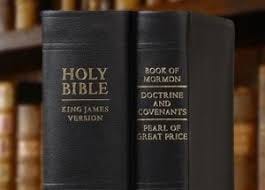
And again, verily I say unto you, let no man pay stock to the quorum of the Nauvoo House unless he shall be a believer in the Book of Mormon, and the revelations I have given unto you, saith the Lord your God;
For that which is more or less than this cometh of evil, and shall be attended with cursings and not blessings, saith the Lord your God. Even so. Amen.
And again, verily I say unto you, let the quorum of the Nauvoo House have a just recompense of wages for all their labors which they do in building the Nauvoo House; and let their wages be as shall be agreed among themselves, as pertaining to the price thereof.
And let every man who pays stock bear his proportion of their wages, if it must needs be, for their support, saith the Lord; otherwise, their labors shall be accounted unto them for stock in that house. Even so. Amen. (D&C 124:119-122)
Much depends upon faith in the word of God contained in the Book of Mormon and in the Doctrine and Covenants. The Lord gave very specific commandments and counsel regarding the financial matters of the Nauvoo House.
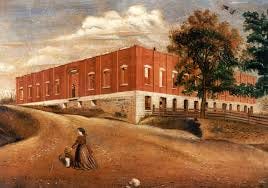
8. Concerning the Nauvoo House.
119-22. Further instructions concerning the Nauvoo House are given here.
- - - - - - - -
(a) Stockholders.
119, 120. The Nauvoo House was to be an hotel, but only those who believed in the Book of Mormon and the Doctrine and Covenants were permitted to hold stock in the association. Unity of faith may not seem essential to a business enterprise, but this house was to be erected for religious purposes; the weary traveler would there “contemplate the glories of Zion” (v. 60). It was essential that the owners of the house should all be of one faith; otherwise those who did not believe in the gospel might object to its principles being taught on their premises.
(b) Compensation.
121, 122. In these paragraphs compensation is provided for work done by all engaged in furthering the interests of the association. “A laborer is worthy of his hire.” (pp. 790-791)
Only those who believed in the Book of Mormon, and the revelations [the Doctrine and Covenants] was another safeguard to keep control of the Nauvoo House within the Church (v. 119). The curses are not specified, but would probably be related to the love of money (see 1 Timothy 6:10). The just recompense of wages for labor is a principle of consecration and stewardship that is from the Lord (D&C 42:72). (p. 497)
The revelation in D&C 124 continues:
Verily I say unto you, I now give unto you the officers belonging to my Priesthood, that ye may hold the keys thereof, even the Priesthood which is after the order of Melchizedek, which is after the order of mine Only Begotten Son.
First, I give unto you Hyrum Smith to be a patriarch unto you, to hold the sealing blessings of my church, even the Holy Spirit of promise, whereby ye are sealed up unto the day of redemption, that ye may not fall notwithstanding the hour of temptation that may come upon you.
I give unto you my servant Joseph to be a presiding elder over all my church, to be a translator, a revelator, a seer, and prophet.
I give unto him for counselors my servant Sidney Rigdon and my servant William Law, that these may constitute a quorum and First Presidency, to receive the oracles for the whole church. (D&C 124:123-126)
We return to the subject of the keys of the Melchizedek Priesthood, a subject about which I have written extensively in previous posts. (See e.g. here, here, here, here, here, here, here, here, and here) At this point in the early history of the Church of Jesus Christ of Latter-day Saints, on January 19, 1841, the Lord designated the Prophet Joseph Smith as a presiding elder over all His Church, and to be a translator, a revelator, a seer, and prophet, holding the keys of the Melchizedek Priesthood. The Lord also called Hyrum Smith to be a patriarch, and conferred upon him the sealing power. As I understand this, Hyrum Smith’s calling election was made sure, and as a co-president of the Church with his brother Joseph Smith, Hyrum Smith also held the keys of the Melchizedek Priesthood. As counselors in the First Presidency, Sidney Rigdon and William Law also held the aforementioned keys and the authority to receive oracles for the whole church.
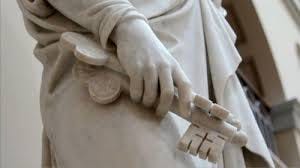
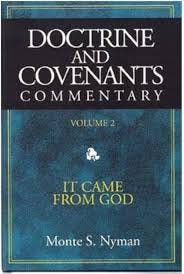
Keys are the directing power of the priesthood. The priesthood is the power of God given to man, but it must be used as directed. The power is delegated through Jesus Christ, whose power it is. As stated before, the priesthood was originally “called the Holy Priesthood, after the Order of the Son of God. But out of respect or reverence to the name of the Supreme Being, to avoid the too frequent repetition of his name, they, the church, in ancient days, called that priesthood after Melchizedek, or the Melchizedek Priesthood” (D&C 107:3-4).
Hyrum was given the keys to bless the Church (v. 124). His blessing did not seal the people unto eternal life, but gave them directions to follow to obtain that blessing unto the day of redemption. In the words of President Joseph Fielding Smith: “The Holy Spirit of Promise is the stamp of approval upon every ordinance that is done righteously; and when covenants are broken he removes the seal.” It was a blessing also to direct one from temptation.
As stated periodically through the Doctrine and Covenants, Joseph was the presiding elder of the Church, with all his other titles (v. 125; see also 90:2; 43:2-3; 28:1-2; 21:4-5). With his two counselors, the quorum of the First Presidency, he holds the oracles, the infallible authority, or the keys for the whole Church. It is the authority not the man that is infallible. The Church is organized to protect it from losing those keys, as discussed in Doctrine and Covenants 107. (p. 498)
The revelation in D&C 124 continues:
I give unto you my servant Brigham Young to be a president over the Twelve traveling council;
Which Twelve hold the keys to open up the authority of my kingdom upon the four corners of the earth, and after that to send my word to every creature.
They are Heber C. Kimball, Parley P. Pratt, Orson Pratt, Orson Hyde, William Smith, John Taylor, John E. Page, Wilford Woodruff, Willard Richards, George A. Smith;
David Patten I have taken unto myself; behold, his priesthood no man taketh from him; but, verily I say unto you, another may be appointed unto the same calling. (D&C 124:127-130)
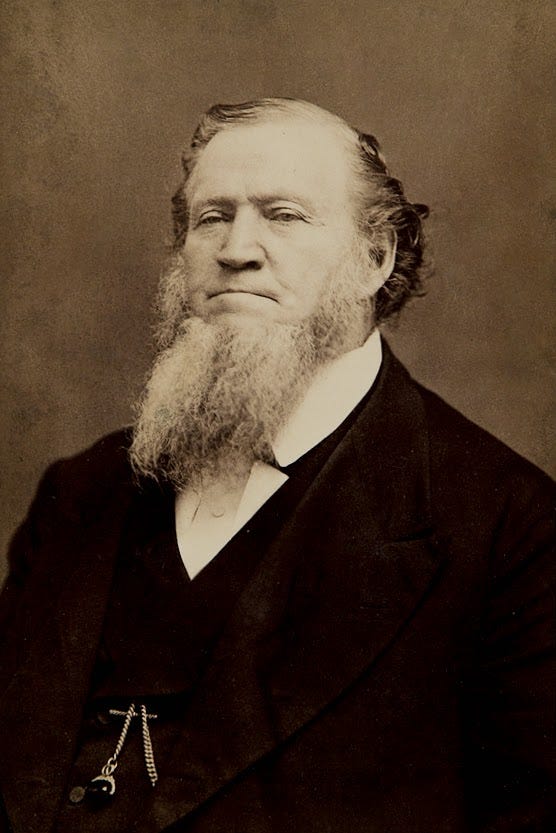
The Lord ordained His servant Brigham Young to be a president over the Twelve traveling council. Brigham Young was and is a controversial figure, but I think that it is important to learn as much about him as possible, and to understand him as he understood himself, before attempting to judge him or cast aspersions upon him. To this end, last night I attend the opening fireside for the LDS Interpreter Foundation’s new media project “Becoming Brigham.” (see also here) It was interesting and informative. Not all of my questions were answered during the fireside, but I discovered helpful resources for learning more about Brigham Young.
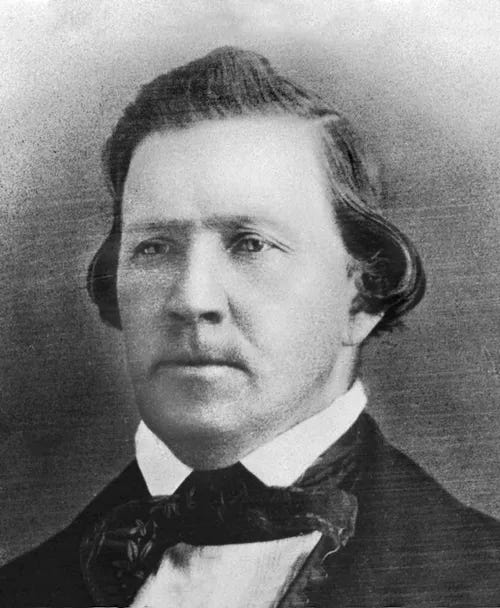
I’ve also read about half of an abridged version of Brigham Young’s Discourses, but there is a lot to unpack. At least we know that the verses above, the Lord appointed Brigham Young as president over the Twelve traveling council, and that this council held the keys for preaching the Gospel to every creature.

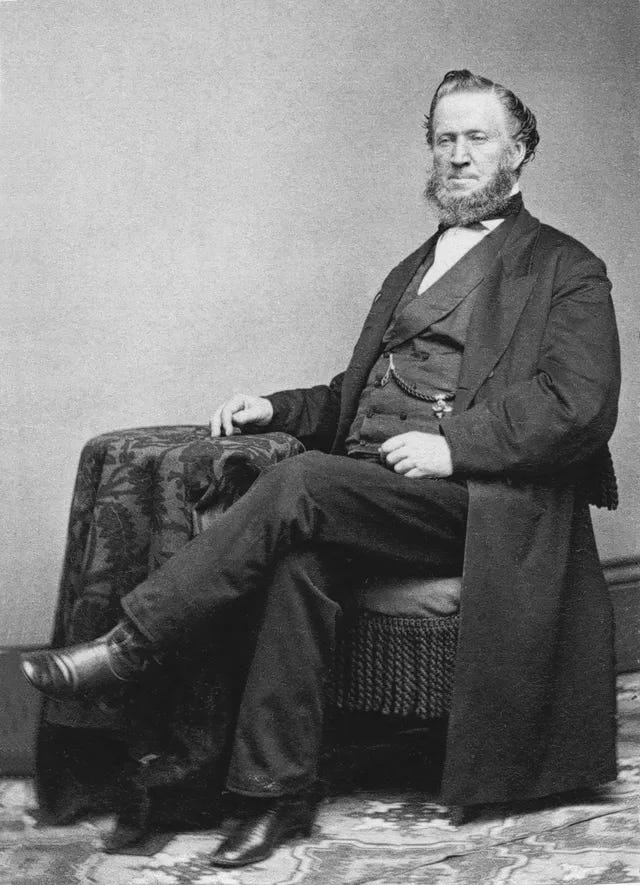
Brigham Young, as the President of the Twelve traveling high council, or the Twelve Apostles (v. 127; see 107:23), held the keys to open the doors of the nations unto the four corners of the earth, to take unto them the kingdom of God, or the restored gospel (D&C 124:128; see 112:21). The Twelve Apostles named here are not the original Twelve, as many had apostatized, and David Patten had been killed. Others had been appointed in their stead (v. 130; see 118:6). About six months later, July 9, 1841, Brigham was given a revelation, at his house (HC, 4:382), through the Prophet Joseph.
D&C 126 * Brigham Young
1 Dear and well-beloved brother, Brigham Young, verily thus saith the Lord unto you: My servant Brigham, it is no more required at your hand to leave your family as in times past, for your offering is acceptable to me.
2 I have seen your labor and toil in journeyings for my name.
3 I therefore command you to send my word abroad, and take especial care of your family from this time, henceforth and forever. Amen.
Brigham’s commandment to remain with his family, at this time, seems to be a preparatory period for him to be ready to lead the church after the martyrdom of the Prophet. His labors as a member of the Twelve had proved his worthiness and qualities for the next step in his mortal probation. (p. 499)
The revelation in D&C 124 continues:
And again, I say unto you, I give unto you a high council, for the cornerstone of Zion—
Namely, Samuel Bent, Henry G. Sherwood, George W. Harris, Charles C. Rich, Thomas Grover, Newel Knight, David Dort, Dunbar Wilson—Seymour Brunson I have taken unto myself; no man taketh his priesthood, but another may be appointed unto the same priesthood in his stead; and verily I say unto you, let my servant Aaron Johnson be ordained unto this calling in his stead—David Fullmer, Alpheus Cutler, William Huntington. (D&C 124:131-132)
Jesus Christ is the Chief Cornerstone of His Church, but this high council in Nauvoo was also a cornerstone of Zion. Nyman writes:
The high council of Zion was probably named as such, instead of the Nauvoo Stake of Zion, because of the designation of the stake as a cornerstone of Zion (D&C 124:2, 23). It apparently had the same function as a stake high council. A corner stake of tent, depending on the shape of the tent, usually has more pressure placed against it. When the New Jerusalem is established as the center place of Zion (see D&C 57:3), the high council may have a different function - although certainly related - than a regular stake high council. (p. 500)
The revelation in D&C 124 continues:
And again, I give unto you Don C. Smith to be a president over a quorum of high priests;
Which ordinance is instituted for the purpose of qualifying those who shall be appointed standing presidents or servants over different stakes scattered abroad;
And they may travel also if they choose, but rather be ordained for standing presidents; this is the office of their calling, saith the Lord your God.
I give unto him Amasa Lyman and Noah Packard for counselors, that they may preside over the quorum of high priests of my church, saith the Lord.
And again, I say unto you, I give unto you John A. Hicks, Samuel Williams, and Jesse Baker, which priesthood is to preside over the quorum of elders, which quorum is instituted for standing ministers; nevertheless they may travel, yet they are ordained to be standing ministers to my church, saith the Lord.
And again, I give unto you Joseph Young, Josiah Butterfield, Daniel Miles, Henry Herriman, Zera Pulsipher, Levi Hancock, James Foster, to preside over the quorum of seventies;
Which quorum is instituted for traveling elders to bear record of my name in all the world, wherever the traveling high council, mine apostles, shall send them to prepare a way before my face.
The difference between this quorum and the quorum of elders is that one is to travel continually, and the other is to preside over the churches from time to time; the one has the responsibility of presiding from time to time, and the other has no responsibility of presiding, saith the Lord your God.
And again, I say unto you, I give unto you Vinson Knight, Samuel H. Smith, and Shadrach Roundy, if he will receive it, to preside over the bishopric; a knowledge of said bishopric is given unto you in the book of Doctrine and Covenants.
And again, I say unto you, Samuel Rolfe and his counselors for priests, and the president of the teachers and his counselors, and also the president of the deacons and his counselors, and also the president of the stake and his counselors. (D&C 124:133-142)
Thus the Lord ordained and called general and local officers, and appointed to them their duties and quorum affiliations. Nyman writes:
The high priests presidency is to qualify, or prepare, men to serve as standing presidents (v. 134). Standing presidents are stake presidents, or bishops who are not literal descendants of Aaron, who are called to serve as bishops of local wards. These officers do not travel to other areas. Men who are called as mission presidents are also high priests who are called to travel for the duration of their mission call (see v. 135). Today, the stake president is the high priest president, and is responsible for the training and selection of men to be bishops, and other leadership roles in the stake and wards.
The seventies are the traveling elders who are called to travel continually under the direction of the Twelve Apostles (vv. 139-140). Their function has changed as the Church has grown. Today there are two quorums who serve as General Authorities and travel throughout the world. Other quorums serve as Regional Authorities and travel throughout their assigned region. As the Church grows, the number of these quorums will increase. The elders preside from time to time as called to do so.
Edward Partridge was called as the first bishop of the Church (D&C 41:9). Newel K. Whitney was later called as the bishop in Kirtland (D&C 72:8). The call of George Miller, in this revelation, was to replace Edward Partridge (D&C 124:20). Therefore, Vinson Knight’s call was to serve as presiding bishop (v. 141). Perhaps Edward Partridge fulfilled both roles during his appointed ministry, but the two offices are now separated. No comment is needed on verse 142. (pp. 501-502)
A lot has changed even since Nyman wrote. As of the beginning of 2026 there are 12 quorums of the Seventy in The Church of Jesus Christ of Latter-day Saints. The First and Second Quorums consist of General Authority Seventies, while the Third through Twelfth Quorums are composed of Area Seventies, designed to accommodate the Church’s global growth.
The revelation in D&C 124 continues and concludes:
The above offices I have given unto you, and the keys thereof, for helps and for governments, for the work of the ministry and the perfecting of my saints.
And a commandment I give unto you, that you should fill all these offices and approve of those names which I have mentioned, or else disapprove of them at my general conference;
And that ye should prepare rooms for all these offices in my house when you build it unto my name, saith the Lord your God. Even so. Amen. (D&C 124:143-145)
The Lord knows how to organize His Church. I am grateful that after describing the many offices and callings and persons called to these positions, the Lord reminds us of the purpose for these offices. The Lord conferred keys or authority upon the various officers of the Church “for helps and for governments, for the work of the ministry and the perfecting of my saints.” In his Epistle to the Ephesians, the Apostle Paul expounded upon this same principle as follows:
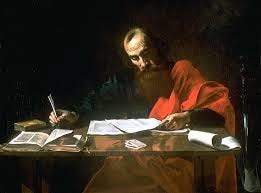
I therefore, the prisoner of the Lord, beseech you that ye walk worthy of the vocation wherewith ye are called,
With all lowliness and meekness, with longsuffering, forbearing one another in love;
Endeavouring to keep the unity of the Spirit in the bond of peace.
There is one body, and one Spirit, even as ye are called in one hope of your calling;
One Lord, one faith, one baptism,
One God and Father of all, who is above all, and through all, and in you all.
But unto every one of us is given grace according to the measure of the gift of Christ.
Wherefore he saith, When he ascended up on high, he led captivity captive, and gave gifts unto men.
(Now that he ascended, what is it but that he also descended first into the lower parts of the earth?
He that descended is the same also that ascended up far above all heavens, that he might fill all things.)
And he gave some, apostles; and some, prophets; and some, evangelists; and some, pastors and teachers;
For the perfecting of the saints, for the work of the ministry, for the edifying of the body of Christ:
Till we all come in the unity of the faith, and of the knowledge of the Son of God, unto a perfect man, unto the measure of the stature of the fulness of Christ:
That we henceforth be no more children, tossed to and fro, and carried about with every wind of doctrine, by the sleight of men, and cunning craftiness, whereby they lie in wait to deceive;
But speaking the truth in love, may grow up into him in all things, which is the head, even Christ:
From whom the whole body fitly joined together and compacted by that which every joint supplieth, according to the effectual working in the measure of every part, maketh increase of the body unto the edifying of itself in love. (Ephesians 1:1-16)
The offices and keys of the priesthood were given for helps [assistance] and government [administering], for the work of the ministry, and for the perfection of the Saints (v. 143). A similar statement was made by Paul to the Saints at Ephesus (4:11-13). The needed unity for the Church to become perfected comes through the priesthood. (p. 502)
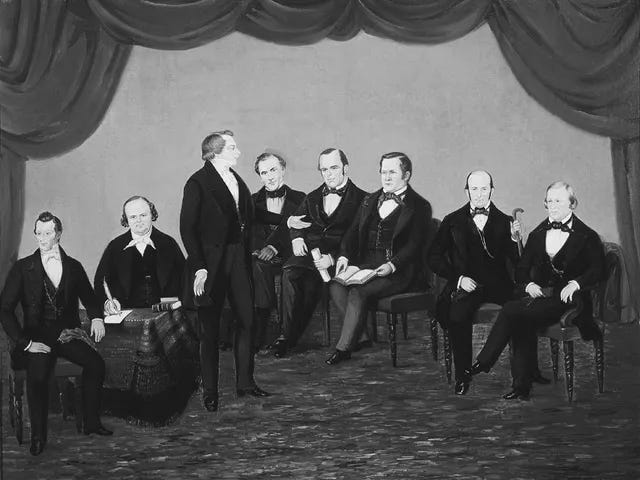
Officers of the Church.
123-145. The officers of the Church are here enumerated in the following order:
Patriarch, Hyrum Smith (v. 124).
First Presidency, Joseph Smith, Sidney Rigdon, William Law (v. 125-6).
President over the Twelve, Brigham Young (v. 127). The Council of the Twelve:
Heber C. Kimball, Parley P. Pratt, Orson Pratt, Orson Hyde, William Smith, John Taylor, John E. Page, Wilford Woodruff, Willard Richards, George A. Smith.
The High Council:
Samuel Bent, H. G. Sherwood, George W. Harris, Charles C. Rich, Thomas Grover, Newel Knight, David Dort, Dunbar Wilson, Aaron Johnson, David Fullmer, Alpheus Cutler, William Huntington.
President of the Quorum of High Priests, Don C. Smith (v. 133), and Counselors, Amasa Lyman and Noah Packard.
Presidency of the Quorum of Elders: John A. Hicks, Samuel Williams, Jesse Baker (v. 137)
First Council of Seventies:
Joseph Young, Josiah Butterfield, Daniel Miles, Henry Harriman, Zera Pulsipher, Levi Hancock, James Foster (v. 138)
The Bishopric: Vinson Knight, Samuel H. Smith, Shadrach Roundy (v. 141)
For Priests: Samuel Rolfe and Counselors.
Teachers.
Deacons.
Presidency of Stakes (v. 142)
Brigham Young] Was born in Whitingham, Windam County, Vermont, June 1st, 1801: In his 22nd year he joined the Methodist church. For a number of years he followed the trades of carpenter, joiner, glazier, and painter. In 1830 he saw, for the first time, a Book of Mormon, which had been left at the house of his brother Phineas, by Samuel H. Smith. In the fall of 1831, he heard some Elders preach and believed. Shortly afterwards he went to Canada, in company with John P. Green, where he visited his brother Joseph and related what he knew of “Mormonism.” His brother accepted the truth and accompanied Brigham to Mendon, where the latter resided. Brigham Young was baptized on the 14th of April, 1832, by Eleazar Miller. After the death of his wife, Brigham Young made his home with Heber C. Kimball, and in September, the same year, the two friends went to Kirtland, where they visited the Prophet Joseph.
General Notes
Brigham Young says:
“Brother Heber and I never went to school until we got into ‘Mormonism’; that was the first of our schooling. We never had the opportunity of letters in our youth, but we hade the privilege of picking up brush, chopping down trees, rolling logs, and working amongst the roots and getting our shins, feet, and toes bruised. *** I learned to make bread, wash the dishes, milk the cows, and make butter. *** Those are about all the advantages I gained in my youth” (Jour. of Dis., Vol. V., p. 97).
“Up to the time that ‘Mormonism’ came to me, I did earnestly pray, if there was a God (and I believed there was), ‘Lord God, Thou who gavest the Scriptures; who didst speak to Abraham and reveal Thyself to Moses and the ancients, keep my feet that they may not be entangled in the snares of folly.’ *** I could not more honestly and earnestly have prepared myself to go into eternity than I did to come into this Church; and when I had ripened everything in my mind, I drank it in, and not till then” (Brigham Young, Jour. of Dis., Vol. VIII., p. 38). (pp. 793-795)
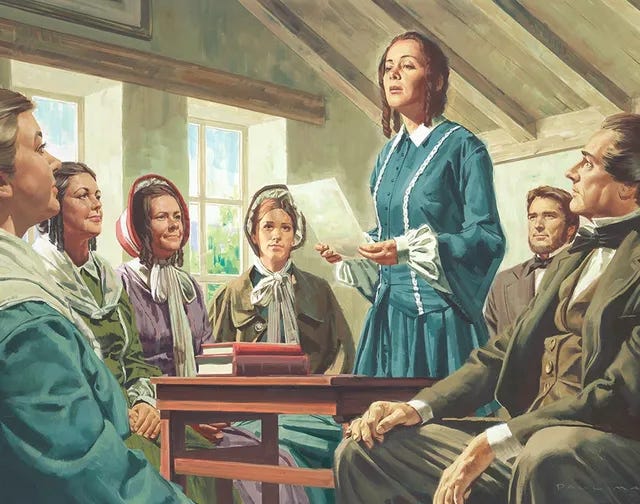
It is also important to note that the Relief Society of the Church of Jesus Christ of Latter-day Saints, which we will study more in the future, was also organized around this time.
Excellent unpacking of how D&C 124 established priesthood structure with specific roles and responsibilities. The parallel you drew between verse 143's language about perfecting saints and Paul's similar language in Ephesians 4 is spot on. That organizational framework wasn't just administrative, it created the scaffoldng for member development. I spent years studying early Church hierarchy and the specificity of these callings really shows how much organizational detail the revelationprovided.