Joseph receives a letter supposedly by the order of John Tyler, the president of the United States, which accuses him of high treason. It turns out to be a farce. He preaches on the death of Lorenzo D. Barnes. He explains the importance of burial, some details about the resurrection, and forbids anyone from leaving a meeting just before it closes: “I don’t care who does it, even if it were the king of England. I forbid it.” (HC 5:360-63.)
Joseph and 100 others go aboard the steamboat Maid of Iowa, take a trip up to Fort Madison, Wisconsin, and return in the evening.
May 11, 1843
Joseph rebaptizes Louisa Beaman, Saray Alley, and others. He meets with the Twelve and calls Capt. Dan Jones on a mission to Wales, James Sloan to Ireland, and other elders to other parts of Great Britain. Elders Addison Pratt, Noah Rogers, Benjamin F. Grouard, and Knowlton F. Hanks are called on missions to the Pacific Isles (Society Islands).
May 12, 1843
Joseph purchases half ownership in the steamer Maid of Iowa, and Capt. Dan Jones begins renting her as a ferry-boat between Nauvoo and Montrose, Iowa.
May 13, 1843
John Taylor publishes an article in the Nauvoo Neighbor encouraging the building of a pottery factory in Nauvoo.
Joseph travels toward Carthage, Ill., with George Miller, William Clayton, Eliza and Lydia Partridge, and others. They stop at Ramus, and Joseph gives instruction to Brother and Sister Benjamin F. Johnson, explaining the necessity of being married in the everlasting covenant. The next morning he preaches about 2 Peter and states, “Paul saw the third heavens and I more. Peter penned the most sublime language of any of the apostles.” (HC 5:391-92.) Other instructions given on these two days are found in D&C 131. (pp. 186-189)
Historical Note. Section 131 consists of a variety of doctrinal statements made by Joseph Smith while visiting members of the Church in Ramus, Illinois. The Prophet’s personal scribe, William Clayton, accompanied him on this occasion and preserved Joseph Smith’s remarks in his personal diary.
On 16 May 1843 Joseph Smith, William Clayton, George Miller, Eliza Partridge, Lydia Partridge, and Lorin Walker traveled to visit the Saints in Ramus. The Prophet and William Clayton spent the evening with Benjamin F. Johnson and the others at the home of William G. Perkins. Before retiring, the Prophet gave Benjamin F. Johnson and his wife some instructions on priesthood, which included verses 1-4 or section 131. Putting his hand on the knee of William Clayton, the Prophet said, “Your life is hid with Christ in God, and so is many others.” Addressing Benjamin F., Joseph said: “Nothing but the unpardonable sin can prevent him [Clayton] from inheriting eternal glory for he is sealed up by the power of the priesthood unto eternal life having taken the step which is necessary for that purpose.” The Prophet continued,
“Except a man and his wife enter into an everlasting covenant and be married for eternity while in this probation by the power and authority of the Holy priesthood they will cease to increase when they die (ie. they will not have any children in the resurrection, but whose who are married by the power & authority of the priesthood in this life & continue without committing the sin against the Holy Ghost will continue to increase & have children in the celestial glory. The unpardonable sin is to shed innocent blood or be accessory thereto. All other sins will be visited with judgment in the flesh and the spirit being delivered to the buffetings of satan untill the day of the Lord Jesus…. Prest J. said that the way he knew in whom to confide, God told him in whom he might place confidence. He also said that in the celestial glory there was three heavens or degrees, and in order to obtain the highest a man must enter into this order of the priesthood and if he dont he cant obtain it. he may enter into the other but that is the end of his kingdom he cannot have increase.”
The following morning, 17 May 1843, the Prophet preached from the first chapter of 2 Peter, when verses 5-6 were recorded,
“At 10 [A.M.] Prest. J. preached on 2nd Peter Ch 1. He shewed that knowledge is power & the man who has the most knowledge has the greatest power. Also that salvation means a mans being placed beyond the powers of all his enemies. He said the more sure word of prophecy meant, a mans knowing that he was sealed up unto eternal life by revelation & the spirit of prophecy through the power of the Holy priesthood. He also showed that it was impossible for a man to be saved in ignorance. Paul had seen the third heavens and I more. Peter penned the most sublime language of any of the apostles.”
In the evening of the same day, the Prophet went to hear Samuel A. Prior, a Methodist preacher. At the close of the preacher’s remarks, Joseph Smith offered some corrections that included verses 7-8:
“P.M. pres. J. attended the City council & afterwards rode out with B. F. Johnsons family. In the evening we went to hear a Methodist preacher lecture. After he got through Pres. J. offered some corrections as follows. The 7th verse of C[hapter] 2 Genesis ought to read God breathed into Adam his spirit or breath of life, but when the word “ruach” applies to Eve it should be translated lives. Speaking of eternal duration of matter he said. There is not such thing as immaterial matter. All spirit is matter but is more fine or pure and can only be discerned by purer eyes We cant see it but when our bodies are purified we shall see that it is all matter. The gentleman seemed pleased & said he should visit Nauvoo immediately.”
Publication Note. Section 131 was first published in the Deseret News (24 September 1856) and was included as section 131 in the 1876 edition of the Doctrine and Covenants. (pp. 291-293)
As doctrinal principles were unfolded to the Prophet Joseph Smith, he gradually taught them to others. Church members learned new truths through personal conversations with the Prophet, listening to him preach, or by reading his letters, revelations, and writings in Church periodicals. Thus, the Nauvoo Saints increased in understanding of the gospel’s eternal beauty.
Some distinctive theological teachings of the Prophet are contained in Doctrine and Covenants 129 through 132, which were recorded during 1843 by William Clayton, the Prophet’s scribe, and were first included in the 1876 edition of the Doctrine and Covenants. (p. 136)
ITEMS OF INSTRUCTION
The instructions recorded in Doctrine and Covenants 130 and 131 were given by the Prophet during two visits to Ramus, about twenty miles east of Nauvoo, when he went to counsel the Church’s substantial branch there. (Ramus is a Latin word meaning “branch.”) On Sunday, 2 April 1843, during the morning meeting, Orson Hyde, who had come to Ramus with the Prophet, preached on the Last Days. “Alluding to the coming of the Savior, he said, ‘When He shall appear, we shall be like Him, &c. He will appear on a white horse as a warrior, and maybe we shall have some of the same spirit. Our God is a warrior (John 14:23). It is our privilege to have the Father and Son dwelling in our hearts, &c.’
“We dined with my sister Sophronia McCleary, when I told Elder Hyde that I was going to offer some corrections to his sermon this morning. He replied, ‘They shall be thankfully received’” (History of the Church, 5:323). These promised corrections as well as other instructions are now embodied in Doctrine and Covenants 130.
One month later, on 16 and 17 May, the Prophet again taught principles of the gospel to members of the Church at Ramus. On 16 May, Joseph Smith and William Clayton spent the evening with Benjamin F. Johnson and others at the home of William G. Perkins. Before retiring, the Prophet instructed Benjamin F. Johnson on the priesthood. “Putting his hand on the knee of William Clayton, the Prophet said, ‘Your life is hid with Christ in God, and so is many others.’ Addressing Benjamin F., Joseph said: ‘Nothing but the unpardonable sin can prevent him [Clayton] from inheriting eternal glory for he is sealed up by the power of the priesthood unto eternal life having taken the step which is necessary for that purpose’” (Revelations, p. 291). Related instructions given during this visit are recorded in Doctrine and Covenants 131.
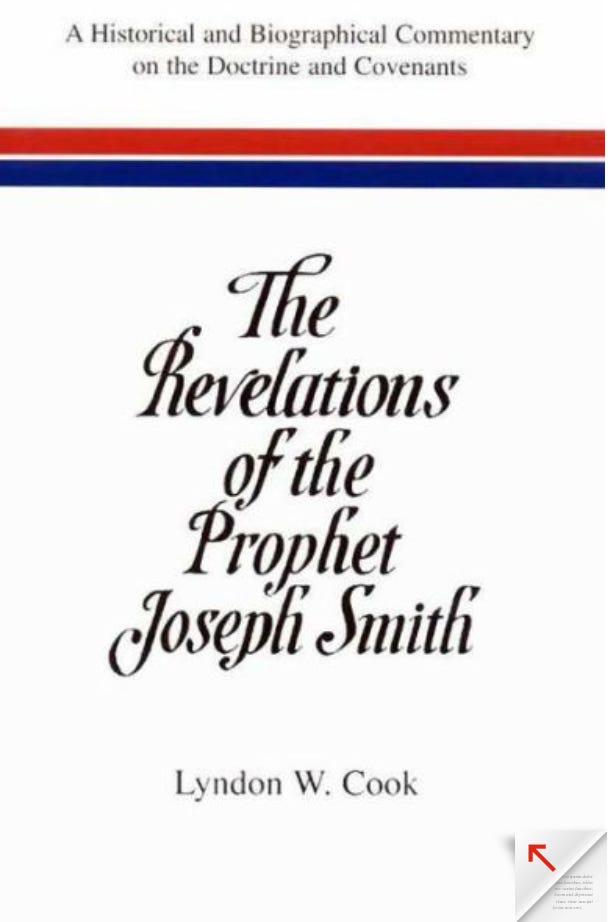
Benjamin F. Johnson remembered these two visits and the truths unfolded at that time: “On April 2d and May 16th 1843 the Prophet was at my house with Wm Clayton as scribe at which time was written in answer to questions asked all of sections 130 & 131 (in the] Doc & Cov and he then gave to us all keys of knowledge contained in sec 129 & 132 of the both before it was written” (Cook, Revelations, p. 290). (pp. 136-137)
Divisions within the Celestial Kingdom (Verses 1-4). This is the clearest scriptural statement concerning the internal structure of the celestial kingdom. Only those who are in the highest of the three divisions are “exalted.” (See the discussion of the celestial kingdom under section 76, and the discussion of celestial marriage under section 132 herein.)
Man Cannot Be Save in Ignorance (verses 5-6). Some have supposed that these verses teach that secular knowledge is essential to salvation. It is true that in order to become as God one must have all knowledge; but when taken together, these verses suggest that the knowledge necessary for entrance into the celestial kingdom is a spiritual knowledge. At some point during progression, all who will eventually be exalted must reach the point at which they have so demonstrated their worthiness that the Lord is able through the Spirit to assure them that they will receive the highest glory in the celestial kingdom. It is possible through living the gospel to receive this “more sure word of prophecy” and make one’s “calling and election sure” while still in mortality. This is the challenge to all Latter-day Saints. (See “The Holy Spirit of Promise,” pp. 110, 125 herein. Sidney B. Sperry’s treatment of sections 131 and 132 also gives valuable insights - see Doctrine and Covenants Compendium, pp. 700-738.)
Spirit Is Matter (Verses 7-8). Most traditional theologies advance a philosophy of dualism by teaching that spirit and matter are opposites. These verses, however, suggest a philosophy of monism - that spirit and matter are of a similar substance but are of a different order or degree of refinement. A resurrected body, for example, is quickened by the spirit rather than by blood so is more refined than a mortal body; yet such a body is still tangible, being of coarser nature than a spirit. This difference in perfection may account for the contrast drawn in the scriptures between the willing spirit and the relatively weaker or more evil flesh. (See, for example, Matthew 26:41; 2 Nephi 2:27-29.) (pp. 198-199)
William Clayton walked the last nine miles to Nauvoo. The boat he and his company had taken down the Mississippi toward their new home had stopped short of Nauvoo for the night. But after an 11-week, 5,000-mile journey from his home in Penwortham, England, William could wait no longer. He and a few friends trudged through the wintry early morning and arrived on foot just before noon, November 24, 1840. A convert of three years, William had testified of Joseph Smith’s prophetic call in his homeland. Now he was eager to meet the Prophet in person.
He soon met Joseph Smith and shared some of his early impressions in letters to his friends back in England. “Last night many of us were in company with Brother Joseph, [and] our hearts rejoiced to hear him speak of the things of the Kingdom,” he wrote. “If I had come from England purposely to converse with him a few days I should have considered myself well paid for my trouble,” he wrote on another occasion.
William set about to make a life and a home for himself and his wife Ruth, who was expecting their second child at the time they arrived. The Claytons’ first year in their new home proved difficult, however. They purchased land on the west side of the Mississippi River, opposite Nauvoo, where they attempted to make a living as farmers. William had been a factory bookkeeper in an industrial English town and had neither the skill nor the physical makeup of a farmer. His efforts were soon toppled by a crop failure and a long bout with malaria.
Brought low by this turn of events, William took the advice of the missionary who had converted him, Heber C. Kimball, and moved his family back across the river to Nauvoo in December 1841. William’s former fellow counselor in the British Mission presidency, Willard Richards, was serving as Joseph Smith’s secretary and needed an assistant he could trust. Heber soon came to William asking him to report to Joseph Smith’s office. There, on February 9, 1842, William agreed to become a secretary and scribe to the Prophet.
Secretary and Scribe
Over the next two and a half years, William Clayton had a closer view of Joseph Smith’s personal and public life than almost anyone. He was with Joseph almost every day and was deeply involved in Joseph’s business, political, and religious affairs. Their friendship gave William a unique opportunity to assess Joseph’s character up close, including his faults. He knew as well as anyone that Joseph was just a man, but for William, Joseph’s shortcomings were unimportant when weighed against the soul-expanding teachings the Lord delivered through His prophet. Through their association in Nauvoo, William became a stubborn lifelong defender of Joseph Smith.
In his work as secretary, William Clayton recorded the most significant revelations, teachings, and sermons given by Joseph Smith during the eventful final two years of the Prophet’s life. He recorded Joseph’s instructions on baptisms for the dead and the revelation on eternal and plural marriage, both of which later became part of the Latter-day Saint scriptures. He was also one of the scribes who kept an account of Joseph’s most well-known sermon, the King Follett discourse. He valued these teachings beyond price and seemed to sense the importance of preserving them.
Joseph Smith felt a growing urgency to communicate spiritual knowledge to the Saints. During his time in Nauvoo he gave one powerful public sermon after another and shared equally powerful teachings and ordinances in private councils with his trusted friends. Joseph Smith did not deliver these teachings as formal revelations the way he often had earlier in his ministry, but William Clayton hung on every word. He recorded the Prophet’s sayings in his own diary or in the journal he kept for Joseph, and these entries were later used as the basis for several sections of the Doctrine and Covenants.
Precious Teachings
William was present when Joseph Smith met with Parley P. Pratt on February 9, 1843, and shared with him knowledge about how to discern heavenly messengers from Satan and his angels. These instructions related to temple teachings that Joseph had shared with members of his trusted circle while Parley had been away in England. William recorded the instructions in Joseph’s journal, and they were later canonized as Doctrine and Covenants 129.
On April 2, 1843, Joseph visited a stake conference in Ramus, Illinois, 20 miles east of Nauvoo. An American religious leader named William Miller had predicted that the Second Coming of Jesus Christ would occur the following day. Joseph took this occasion to assure the Saints in Ramus that the Lord had not revealed the time of His coming. Joseph also taught that God was an embodied personage; that all things past, present, and future are present before Him; and that our social relationships will endure in the eternities. William Clayton’s record of these gems in his personal journal became the basis for the text of Doctrine and Covenants 130.
Doctrine and Covenants 131 is composed largely of several short journal entries kept by William during May 1843. Among these were teachings regarding eternal marriage given in Ramus at the home of Benjamin and Melissa Johnson on May 16. The Johnsons had been married since Christmas Day 1841, but Joseph told them he intended to marry them according to the law of the Lord. Benjamin jokingly said he would not marry Melissa again unless she courted him. But Joseph was in earnest. He taught that men and women needed to enter into the new and everlasting covenant of marriage in order to obtain God’s highest blessings. He then sealed Benjamin and Melissa for eternity.
For William, recording these prophetic utterances was more than a duty; it was one of the great privileges of his life. He thrilled at the way Joseph Smith collapsed the distance between this world and the next and made the things of eternity feel tangible and real. When the Nauvoo Saints listened to Joseph speak, the many hardships they faced—death, sickness, poverty, and hunger—were swallowed up in anticipation of a millennial future and the promise that ties of family and friendship would outlast this life. William Clayton’s delight in recording the words of Joseph Smith has had a lasting influence on Church teachings and continues to bless Latter-day Saints today. (pp. 277-280)
JS, Instruction, [Macedonia, Hancock Co., IL, 16 May 1843]. Featured version copied [ca. 19 May 1843] in William Clayton, Journal, 25 Apr. 1843–24 Sept. 1844, pp. [13]–[16]; handwriting of William Clayton; William Clayton, Journals, 1842–1846, CHL. For more information, see the source note for William Clayton, Journal, 25 Apr. 1843–24 Sept. 1844, in JSP, D12 (forthcoming).
Historical Introduction
On 16 May 1843 at the residence of Benjamin F. Johnson in Macedonia, Illinois, JS instructed William Clayton, Johnson, and Melissa LeBaron Johnson, Benjamin’s wife, “on the priesthood.”1 Benjamin Johnson recalled that “in the evening,” JS invited him and Melissa “to come and sit down, for he wished to marry us according to the law of the Lord. I thought it a joke, and said I should not marry my wife again, unless she courted me, for I did it all, the first time. He chided my levity, told me he was in earnest, and so it proved; for we stood up and were sealed by the Holy Spirit of promise.”2 Contemporaneous records, however, show that when he later recounted the story, Johnson conflated when he first heard this teaching and when he and Melissa were actually sealed. According to William Clayton’s journal, the couple was “united in an everlasting covenant” on 20 October 1843.3
JS taught that if a man and a woman were sealed as husband and wife by the power of the priesthood, their marriage would continue beyond death, and they would live together in marriage in the highest level of heaven. His teachings included the idea that couples properly sealed would have “children in the resurrection.”4 Based on JS’s statement to Johnson that he knew in whom he could confide, it seems he expected the Johnsons not to discuss this doctrine with others.
William Clayton was present during JS’s instruction and took notes. However, based on the uniformity of the ink flow and character formation in his journal, it appears that Clayton created the entries covering 14 May through most of 19 May in one sitting. It is likely the entries were based upon earlier notes that are no longer extant.5
He put his hand on my knee6 and says “your life is hid with Christ in God.” and so is many others”.7 Addressing [p. [13]] Benjamin [F. Johnson] says he “nothing but the unpardonable sin8 can prevent him (me)9 from inheriting eternal glory for he is sealed up by the power of the priesthood unto eternal life having taken the step which is necessary for that purpose.”10 He said that except a man and his wife enter into an everlasting covenant and be married for eternity while in this probation by the power and authority of the Holy priesthood they will cease to increase when they die (i e) they will not have any children in the resurrection, but those who are married by the power & authority of the priesthood in this life & continue without committing the sin against the Holy Ghost will continue to increase & have children in the celestial [p. [14]] glory. The unpardonable sin is to shed innocent blood or be accessory thereto.11 All other sins will be visited with judgement in the flesh and the spirit being delivered to the buffetings of Satan12 untill the day of the Lord Jesus.”13 I feel desirous to be united in an everlasting covenant to my wife and pray that it may soon be.14
prest. J. said that they way he knew in whom to confide.15 God told him in whom he might place confidence. He also said that [1]in the celestial glory there was three heavens or degrees,16[2]and in order to obtain the highest a man must enter into this order of the priesthood [3]and if he dont he cant obtain it. [4]He may enter into the other but that is the end of his kingdom [p. [15]] he cannot have an increase.
Discourse, 17 May 1843–A
Source Note
JS, Discourse, [Macedonia, Hancock Co., IL, 17 May 1843]. Featured version copied [ca. 19 May 1843] in William Clayton, Journal, 25 Apr. 1843–24 Sept. 1844, p. [16]; handwriting of William Clayton; William Clayton, Journals, 1842–1846, CHL. For more information, see the source note for William Clayton, Journal, 25 Apr. 1843–24 Sept. 1844, in JSP, D12 (forthcoming).
Historical Introduction
On 17 May 1843, JS preached a discourse in Macedonia, Illinois, on the first chapter of 2 Peter in the New Testament. In the discourse, JS revisited a subject he had addressed three days before in Morley Settlement, Illinois—the individual Christian believer’s obtaining assurance of having eternal life.17 As he did in the earlier discourse, JS emphasized the importance of knowledge in this process and explained the “more sure word of prophecy” mentioned in 2 Peter 1:19, which he interpreted as receiving divine confirmation of being “sealed up unto eternal life.” In this 17 May discourse, JS indicated that this divine affirmation would come through the priesthood.
Having been apprised on the evening of 16 May 1843 that JS planned to preach the following day, the Saints congregated at 10:00 a.m. on 17 May, possibly in a schoolhouse built by church members in Macedonia.18 Samuel Prior, a Methodist preacher who was visiting Macedonia to observe the Latter-day Saints in general and JS in particular, attended the meeting and subsequently wrote an account of his experience, which was published in the Times and Seasons. Prior described taking his “seat in a conspicuous place in the congregation” and waiting for JS’s arrival, after which JS “commenced calmly and continued dispassionately to pursue his subject. … He glided along through a very interesting and elaborate discourse, with all the care and happy facility of one who was well aware of his important station, and his duty to God and man, and evidencing to me, that he was well worthy to be styled ‘a workman rightly dividing the word of truth,’ and giving without reserve, ‘saint and sinner his portion in due season.’” Prior stated, “I was compelled to go away with a very different opinion from what I had entertained when I first took my seat to hear him preach.”19
William Clayton, who accompanied JS to Macedonia, wrote an account of the discourse in his journal. The relatively polished nature of the featured text suggests that Clayton reconstructed JS’s words after the fact, likely from notes taken at the time. Based on the uniformity of the ink flow and character formation in his journal, it appears that Clayton created the entries covering 14 May through most of 19 May in one sitting. The original notes are apparently not extant.
He shewed that knowledge is power & the man who has the most knowledge has the greatest power.20 Also that Salvation means a mans being placed beyond the power of all his enemies. [5]He said the more sure word of prophecy meant, a mans knowing that he was sealed up unto eternal life by revelation & the spirit of prophecy,21 through the power of the Holy priesthood.22[6]He also showed that it was impossible for a man to be saved in ignorance.23 Paul had seen the third heavens24 and I more.25 Peter penned the most sublime language of any of the apostles. [p. [16]]
Discourse, 17 May 1843–B
Source Note
JS, Discourse, [Macedonia, Hancock Co., IL, 17 May 1843]. Featured version copied [ca. 19 May 1843] in William Clayton, Journal, 25 Apr. 1843–24 Sept. 1844, p. [18]; handwriting of William Clayton; William Clayton, Journals, 1842–1846, CHL. For more information, see the source note for William Clayton, Journal, 25 Apr. 1843–24 Sept. 1844, in JSP, D12 (forthcoming).
Historical Introduction
On the evening of 17 May 1843, JS preached a discourse in Macedonia, Illinois, in response to a sermon given by Samuel Prior, a visiting Methodist preacher, who had been “invited to preach” earlier that evening before a “large and respectable” congregation of Latter-day Saints.26 Prior wrote an article that was published in the Times and Seasons shortly after JS gave the sermon featured here.27 After Prior delivered his unrecorded discourse, JS sought to correct Prior’s interpretation of Genesis 2 and the “eternal duration of matter”—doing so “mildly, politely, and affectingly,” according to Prior.28
During his remarks, JS questioned the King James Bible’s language in Genesis 2:7, which states, “The Lord God formed man of the dust of the ground, and breathed into his nostrils the breath of life; and man became a living soul.” According to Clayton’s notes of the discourse, JS also discussed aspects of Hebrew in his argument. JS argued that the “breath of life” referred to Adam’s spirit, and he included comments on the Hebrew word ruach (breath or spirit), arguing that when the word is applied to Eve, life should be rendered lives.29
Genesis 2:7 prompted pronouncements from religious thinkers of JS’s era on the nature of bodies and souls and on their duration throughout eternity. Methodist minister Adam Clarke, for instance, wrote that “man is a compound being, having a body and a soul, distinctly and separately created; the body out of the dust of the earth, the soul immediately breathed from God himself.”30 A widely circulated nineteenth-century theological dictionary stated that the “generally received opinion” held that the human soul “began to exist in his mother’s womb.”31 Though it is impossible to reconstruct Prior’s sermon, JS’s response makes clear that Prior used his sermon to engage this topic. JS responded to Prior and offered his own thoughts on the nature of the human spirit.
JS’s own teachings about the soul and matter differed from those of other Christians of his day in some important respects. Common teachings stated that the soul consisted of “the vital, immaterial, active substance, or principle, in man.”32 For some years, JS had taught that all beings were composed of eternal matter. A May 1833 revelation stated that “the Elements are eternal.”33 On 30 August 1840, JS preached a “discourse on Eternal Judgement and the Eternal Duration of matter.”34 In 1842, JS published an editorial directly opposing the traditional idea that the spirit was immaterial. He argued, much as he did in the discourse featured here, that “the body is supposed to be organized matter, and the spirit by many is thought to be immaterial, without substance. With this latter statement we should beg leave to differ—and state that spirit is a substance; that it is material, but that it is more pure, elastic, and refined matter than the body.”35 Also in 1842, the published Book of Abraham stated that “the Gods formed man from the dust of the ground, and took his spirit, that is the man’s spirit, and put it into him, and breathed into his nostrils the breath of life, and man became a living soul.”36 The discourse featured here shares the Book of Abraham’s emphasis on the eternal nature of humankind and the idea that spirits were embodied at birth.
William Clayton was present during JS’s discourse and took notes. However, based on the uniformity of the ink flow and character formation in his journal, it appears that Clayton created the entries covering 14 May through most of 19 May in one sitting. It is likely the entries were based upon earlier, nonextant notes.
The 7th verse of c 2 of Genesis ought to read God breathed into Adam the his spirit or breath of life. but when the word “ruach”37 applies to Eve it should be translated lives.38
Speaking of eternal duration of matter he said. [7]There is no such thing as immaterial matter. All spirit is matter but is more fine or pure and can only be discerned by purer eyes [8]We cant see it but when our bodies are purified we shall see that it is all matter.39 [p. [18]]
Ramus, where this Revelation was received, was a settlement situated about 22 miles southeast of Nauvoo. The Prophet often visited this place and preached some powerful discourses there.
On the 16th of May, 1843, a little company, consisting of Joseph Smith, George Miller, William Clayton, Eliza and Lydia Partridge, and J. M. Smith, went to Ramus. The Prophet and William Clayton stayed and Benjamin F. Johnson’s over night. Before retiring, the little party of friends engaged in conversation on spiritual topics. The Prophet told them that “except a man and his wife enter into an everlasting covenant and be married for eternity, while in this probation, by the power and authority of the holy Priesthood, they will cease to increase when they die; that is, they will not have any children after the resurrection.” Then he spoke of the unpardonable sin, explaining that it consists in shedding innocent blood, or being accessory thereto. “All other sins,” he said, “will be visited with judgment in the flesh, the spirit being delivered to the buffetings of Satan until the day of the Lord Jesus.” Then he spoke of the three heavens in the celestial glory, as recorded in the first four verses of this Revelation. See also footnote, page 285. (p. 818)
Historical Setting: “Tuesday, [May] 16…. Remarks of the Prophet at Ramus - Lives that are Hid with God in Christ - Importance of the Eternity of the Marriage Covenant” (HC, 5:391).
“Wednesday, [May] 17…. Items of Doctrine by the Prophet” (HC, 5:392) (p. 529)
Through Joseph Smith, the Lord took some of the mystery out of eternity. The greatness of God, the glory of heaven, and the vastness of eternity can seem almost familiar in the light of the restored gospel, even to finite minds like ours. The revelations in Doctrine and Covenants 129–32 are a good example. What is God like? He “has a body … as tangible as man’s.” What is heaven like? “That same sociality which exists among us here will exist among us there” (Doctrine and Covenants 130:22, 2). In fact, one of the most joyous truths about heaven is that it can include our cherished family relationships, if sealed by the proper authority. Truths like these can make heaven feel less distant—glorious yet reachable.
But then, sometimes God may ask us to do things that seem uncomfortable and unreachable. For many early Saints, plural marriage was one such commandment. It was a severe trial of faith for Joseph Smith, his wife Emma, and almost everyone who received it. To make it through this trial, they needed more than just favorable feelings about the restored gospel; they needed faith in God that went far deeper than that. The commandment no longer stands today, but the faithful example of people who lived it still does. And this example inspires us when we are asked to make our own “sacrifices in obedience” (Doctrine and Covenants 132:50).
There are many things we don’t know about exaltation or life in the highest degree of the celestial kingdom—the kind of life God lives. Much of it may be beyond our current ability to understand. But God has revealed a few precious clues, and many of them are found in Doctrine and Covenants 130–32. You might read with questions like these in mind: What do I learn about God? What do I learn about the life after mortality? How does this information about eternal life bless my life now?
The new and everlasting covenant of marriage is a portion of the new and everlasting covenant, which is the fulness of the gospel. It is a sacred marriage, solemnized between husband and wife in one of the holy temples of the Lord and performed by one authorized of the Lord through His earthly prophet. It is an everlasting marriage and endures throughout eternity.
President George Q. Cannon has written: “We believe that when a man and woman are united as husband and wife, and they love each other, their hearts and feelings are one, that that love is as enduring as eternity itself, and that when death overtakes them it will neither extinguish nor cool that love, but that it will brighten and kindle it to a purer flame, and that it will endure through eternity” (JD 14:320-21).
Only those who enter into this order of marriage, and through their life-long righteousness have this relationship ratified, will receive the blessings of exaltation and eternal increase, as husband and wife together, throughout the eternities (D&C 131:1-4; 132:4, 7, 18-20). (p. 382)
See also: Everlasting Covenant; New and Everlasting Covenant; Time
The fulness of the gospel of Jesus Christ (D&C 66:2). It is new every time it is revealed anew following a period of apostasy. It is everlasting in the sense that it is God’s covenant and has been enjoyed in every gospel dispensation where people have been willing to receive it. The new and everlasting covenant was revealed again to men on earth by Jesus Christ through the Prophet Joseph Smith. It contains sacred ordinances administered by priesthood authority—such as baptism and temple marriage—that provide for man’s salvation, immortality, and eternal life. When people accept the gospel and promise to keep God’s commandments, God covenants to give them the blessings of His new and everlasting covenant.
I will establish my covenant between me and you, Gen. 17:7.
He shall have the covenant of an everlasting priesthood, Num. 25:13.
The people changed the ordinances and broke the everlasting covenant, Isa. 24:5 (D&C 1:15).
The new and everlasting covenant] The new and everlasting covenant is the fulness of the Gospel, in other words, the sum total of all the covenants, contracts, bonds, obligations, etc. that belong to the Gospel. Marriage for time and eternity is not the new and everlasting covenant, but one of the covenants which belong to the new and everlasting covenant.
On the 17th of May the Prophet preached a discourse on II. Peter 1, and showed that knowledge is power. Among the truths announced at this time was that recorded in the 5th and 6th verses of this Revelation.
In the evening the Prophet went to hear a Methodist preach. After the sermon he offered some corrections. On Gen. 2:7 he observed that it ought to read: “God breathed into Adam his [that is, Adam’s] spirit or breath of life;” but when the word ruach applies to Eve, it should be translated “lives.”
He added the truths recorded in the 7th and 8th verses of this Revelation. (p. 819)
About two months before section 132 was recorded - it was given long before (see section heading below) - the Prophet Joseph taught the above doctrine. He also taught that to have an increase is to have children after a husband and wife are resurrected. “Except a man and his wife enter into an everlasting covenant and be married for eternity, while in this probation, by the power and authority of the Holy Priesthood, they will cease when they die; that is, they will not have any children after the resurrection. But those who are married by the power and authority of the priesthood in this life, will continue to increase and have children in the celestial glory.”
Therefore, there is no marriage in the lower two kingdoms of the celestial glory, or in the terrestrial or telestial glory. (pp. 529- 530)
(May 17th, 1843.) The more sure word of prophecy means a man’s knowing that he is sealed up unto eternal life, by revelation and the spirit of prophecy, through the power of the Holy Priesthood.
The more sure word of prophecy is another term for having your calling and election made sure, or receiving the Second Comforter. This subject was discussed in chapter 8 under Doctrine and Covenants 88:1-5. It comes by revelation and through the power of the priesthood (vv. 5-6). It is a sacred calling, and not discussed openly. Only those who have the experience know about it, but one cannot be saved without it.
The Prophet Joseph stated a month earlier: “Salvation is nothing more nor less than to triumph over all our enemies and put them under our feet. And when we have power to put all enemies under our feet in this world, and a knowledge to triumph over all evil spirits in the world to come, then are we saved, as in the case of Jesus, who was to reign until He had put all enemies under His feet, and the last enemy was death” (TPJS, 297).
The “more fine or pure” matter (vv. 7-8) was also commented on by the Prophet about a year earlier: “… The spirit is a substance that it is material, but that it is more pure, elastic and refined matter than the body; that it existed before the body, can exist in the body; and will exist separate from the body, when the body will be mouldering in the dust; and will in the resurrection, be again united with it” (TPJS, 207). The Prophet’s statement in the previous section seems to fit well with these statements: “Whatever principle of intelligence we attain in this life, it will rise with us in the resurrection.
And if a person gains more knowledge and intelligence in this life through his diligence and obedience that another, he will have so much the advantage in the world to come” (D&C 130:18-19). Not only will the spirit and the body be reunited, but all that the spirit has learned on earth will be retained in the soul - “The glory of God is intelligence, or, in other words, light and truth” (D&C 93:36) - “the spirit and the body are the soul of man” (D&C 88:15). Celestial souls will be on the path to become like God. (pp. 530-531)
On his return home from Ramus, on the 18th of May, 1843, the Prophet took dinner with Judge Stephen A. Douglas, at Carthage, and gave him, at his request, a detailed account of the persecutions the Saints had suffered. He concluded his narrative with a prophecy which B. H. Roberts considers “one of the most remarkable prophecies either in ancient or modern times” (Hist. of the Church, Vol. V., p. 395). The Prophet concluded as follows:
“Judge, you will aspire to the presidency of the United States; and if ever you turn your hand against me or the Latter-day Saints, you will feel the weight of the hand of the Almighty upon you; and you will live to see and know that I have testified the truth to you; for the conversation of this day will stick to you through life.”
Judge Douglas did aspire to the presidency so effectively that, on the 23rd of June, 1860, he was nominated by the Democratic party. Judging from appearances, his election was sure, for his party, in the preceding election, polled over half a million votes more than the opposing parties. But the Judge failed miserably. On the 12th of June, 1857, he turned his hand against the Latter-day Saints, in spite of the warning of the Prophet, when, in a speech delivered at Springfield, Ill., he accused the Latter-day Saints, then living in Utah, of all the crimes known to the penal code, well knowing that he did so falsely, to gain favor among the enemies of the Church. The result was as the Prophet had told him would be the case, he was defeated. Abraham Lincoln carried 18 States; Breckinridge, 11; Bell, 3; and Judge Douglas, only one! Less than a year after his nomination he died, disappointed, heartbroken, only 48 years of age (Hist. of the Church, Vol. V., pp. 393-8). The prophecy was fulfilled to the letter, and, incidentally, the Lord demonstrated to the world that He recognized the Church in the Valleys of the Mountains as His people; for it was because of his attitude toward the Saints there that he sealed his own doom. (p. 819)